Anthropeum: How to Read the Object, Map and Timeline
Anthropeum asks two questions about each museum object: where was it made, and when? The captured game screen shows the object, its material, a map and a timeline. Use all four before submitting.
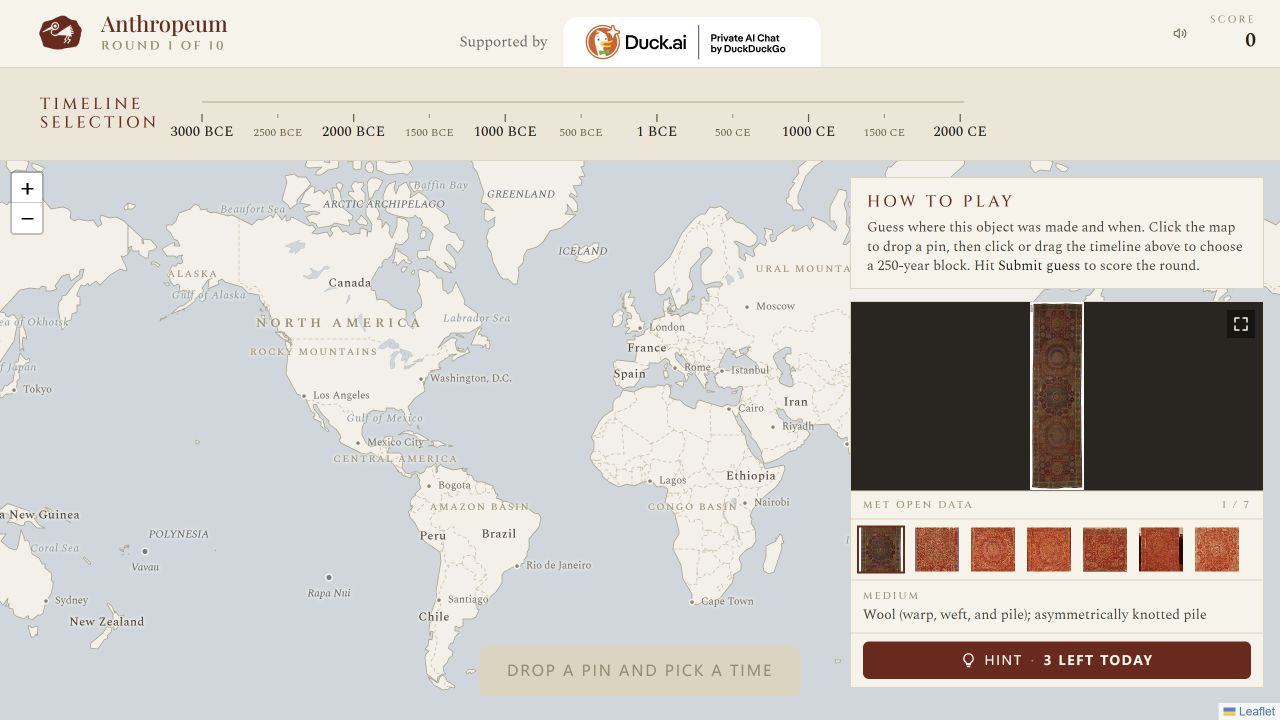
Start with what is visible
Examine the full object and its close views before using a hint. Look for a material, technique, writing, pattern or shape that might suggest a region or time period. Treat those details as clues, not proof of origin.
Make the location guess
Place a pin on the world map for the most plausible production location. If the evidence points only to a broad area, start there instead of choosing a precise city without support. Closer locations score better.
Choose a time block
The timeline stretches across BCE and CE dates. The on-screen instructions say to click or drag it to choose a 250-year block. Check that the selected block matches the era suggested by the object before submitting.
Learn from both results
Each daily game has ten objects. When a round ends, compare the actual place and period with both guesses separately. If one part was close and the other far away, preserve the useful visual clue and revise only the weaker inference next time.
What the screen gives you
The captured round displays a photographed object, several close views, a material label, a world map and a BCE-to-CE timeline. Those are the evidence available before you use a hint.
A useful post-round note
After each object, remember one observation that helped and one that misled you. This is more useful than memorizing the daily answer because the next round shows a different object.
Next-round checklist
- Inspect the object and its close views.
- Place a map pin and select a 250-year block.
- Review location and time errors separately.
Keep this handy
Use the game page for the original play link and captured screens, or choose another guide for a different scoring style.